
What a floor is made of decides how it holds up: how it copes with humid air, how it takes everyday knocks, and whether it can go down without tearing out the floor beneath it. Kirin’s SPC Flooring is built on a Stone Plastic Composite (SPC) core, a material we chose for the way homes and businesses in Sri Lanka are actually built and lived in.
In this article, we cover what goes into each plank, what the stone core does, how the floor is laid over existing tile, and how it compares with PVC laminate, WPC and tile.
Kirin's SPC Flooring is plank flooring with an SPC core: powdered limestone bound with PVC and stabilisers, formed into a solid board under heat and pressure. A printed wood or stone design and protective layers sit on top, and the planks lock together edge to edge.
In Sri Lanka, laminate usually means a PVC plank with a printed design under a clear wear layer. Kirin's SPC Flooring is built the same way, with one difference in the core: limestone powder is mixed into the PVC, which turns a flexible plank into a rigid one. The floor is not glued down; it floats on the surface below.
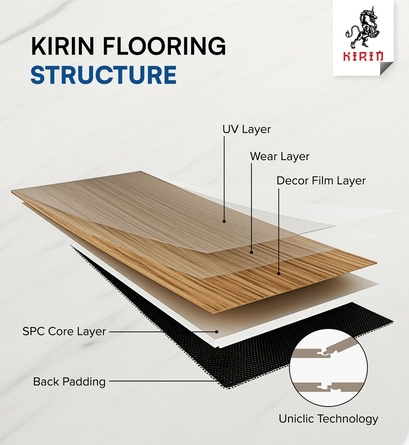
Every plank is built from five layers.
UV layer: A thin coating hardened with ultraviolet light during manufacture. It takes everyday scuffs and stains, so spills wipe off instead of soaking in.
Wear layer: A clear layer over the printed design. Grit, chair legs and pet claws mark this layer rather than the pattern beneath it, so its thickness decides how long the floor resists visible scratching.
Decor film layer: A high-resolution print of wood grain or stone texture. This film gives a wood-look or stone-look plank its appearance; the plank contains no timber or quarried stone.
SPC core: The rigid board that carries the plank's strength and stability.
Back padding: A backing that softens footfall and reduces the hollow sound a hard floor can make.
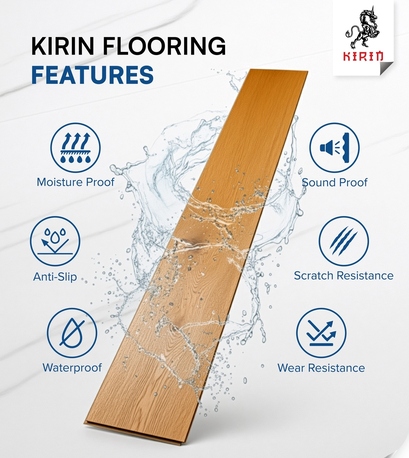
The limestone makes the core dense and stiff. A dense, stiff core does not swell when moisture reaches it, barely changes size as temperatures rise and fall, resists dents, and spans small dips in the floor below instead of sinking into them.
Humidity is where this matters most. Relative humidity in Sri Lanka generally runs from about 70% in the day to 90 to 95% at night. Floors with wood-based cores take on moisture on humid nights and give it up during the day, and that repeated movement is what opens gaps and lifts joints. An SPC core does not take up that moisture, so the planks keep their size through the daily cycle and through air conditioning switching on and off.
Stiffness is what separates it from PVC laminate. A flexible PVC plank follows the surface beneath it, so grout lines and small dips in an old tiled floor can show through, and a dropped pan or a heavy chair leg can leave a dent. The limestone in the core resists that pressure and lets each plank bridge grout lines, so the new surface stays flat over existing tile.
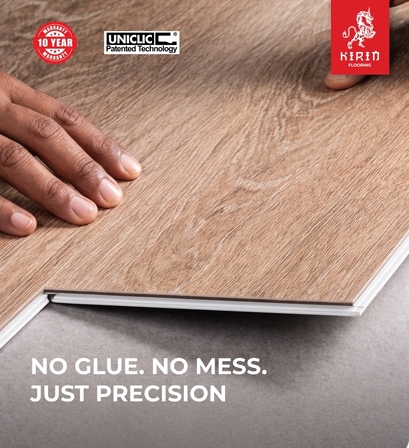
The planks join with Uniclic, a patented click-lock system licensed from Unilin. The tongue on one plank locks into the groove of the next, held by a flexible lower lip, so the floor goes down without glue, nails or special tools.
A Uniclic plank can be locked in two ways: angled down into its neighbour, or pushed in flat, which helps under door frames where there is no room to lift a plank. The joint profile pulls neighbouring planks tightly together so the seams stay closed, and spacing within the profile reduces creaking underfoot. Because the finished floor floats, a small gap is left at the walls so it can move slightly, and the skirting covers that gap.
Yes, in most homes. The existing tiled floor needs to be sound, clean, and reasonably flat. The new planks float on top of it, so the old tile stays in place and nothing is broken out.
Before installation, a few things are checked and fixed:
Loose or hollow tiles: These are re-fixed or filled, because a tile that moves underneath will move the plank above it.
Large level differences: Dips or steps too deep for the plank to span are levelled first.
Doors: Doors may need trimming at the bottom to clear the small increase in floor height.
Doorways: A transition strip finishes the edge where the new floor meets another room.
Skipping demolition removes the most disruptive part of re-flooring a lived-in house: no hacking out tile, no adhesive, and no curing wait.
The biggest difference between these floors is what sits underneath the surface. The core decides how stiff a plank is, how it handles dents and moisture, how it feels underfoot, and how much work the floor below needs before it goes down. Here is how SPC, PVC laminate, WPC (wood-plastic composite) and tile compare.
SPC | PVC laminate | WPC | Tile | |
Core | Limestone and PVC | PVC | Wood fibre and plastic | Fired ceramic or porcelain |
Water and humidity | Does not take on moisture or swell | Does not swell, but moves more with heat | Resists spills, but its wood fibre can take on moisture in humid air | Suits wet areas |
Dents | Resists dents | Dents more easily | Dents more easily | Very hard surface |
Over existing tile | Bridges grout lines | Grout lines can show through | Bridges small dips | Needs adhesive and a level base |
Underfoot | Firm | Thin and flexible | Softer and quieter | Hard and cool |
Installation | Clicks together, floats | Glued down or clicks together | Clicks together, floats | Adhesive, grout and curing time |
Kirin SPC flooring prices in Sri Lanka are quoted per square foot in LKR. The rate depends on wear-layer and plank thickness, the design, how much preparation the subfloor needs, and installation.
A thicker wear layer costs more because it resists visible scratching for longer. Laying over existing tile lowers the total, because there is no demolition or debris removal to pay for.
Quotes are easiest to compare on the installed price per square foot rather than the material price alone.
We build Kirin Flooring on an SPC core because most homes here are humid and already tiled. A core that holds its size and floats over the existing floor lets us re-floor a room without breaking anything out, which is how 99% of our installations are done.
Every plank locks together with the patented Uniclic click-lock system, licensed from Unilin, so there is no glue and no curing time. Kirin's SPC Flooring in Sri Lanka is FloorScore certified, an independent indoor-air-quality certification for low chemical emissions.
The same construction works beyond the home. Kirin Flooring is laid in homes, offices, coffee shops, schools and showrooms. A floor that resists dents, wipes clean and goes down without demolition suits a busy shop or classroom as well as a living room.
The range covers warm wood-look planks and cleaner stone-look finishes, so one floor can match a traditional living room or a modern office. The full range is on our products page.
The floor you choose decides how a room holds up to humid air, daily wear, and the years ahead. Kirin’s SPC Flooring is built to handle all of it, and it goes in without tearing out the floor you already have.
The best way to judge any floor is in your own space. Ask us for a sample to check the design in your light, and a per-square-foot quote for your room.
The lifespan of Kirin's SPC Flooring depends mainly on the thickness of its wear layer and how heavily the room is used, because foot traffic and furniture slowly wear that layer away. The core itself does not rot or swell with humidity, so in a home the surface, not the plank, is what eventually shows age.
Clean Kirin Flooring by sweeping or vacuuming to remove grit, then wiping with a damp, well-wrung mop. Grit is what scratches a floor, so regular sweeping does most of the work. Wipe spills up instead of letting them sit, and use a doormat at entrances to stop grit coming in.
Pets and chair legs are unlikely to dent an SPC floor, because the dense core resists pressure. Claws and dragged furniture can scratch the wear layer over time. Felt pads under chair and table legs, and keeping pets' nails trimmed, reduce that wear.
Solid timber takes on and releases moisture as humidity changes, so it can swell, shrink or cup in a humid house. An SPC core holds its size through the same changes. Timber's advantage is that it can be sanded and refinished to remove wear, which Kirin's planks cannot.
Yes. Kirin's SPC Flooring has the same laminated build as the PVC laminate common in Sri Lanka: a UV layer, a clear wear layer and a printed design film bonded to a core. The difference is the core itself. It is SPC, PVC mixed with limestone powder, so each plank is rigid rather than flexible.
Yes. SPC vinyl flooring is another name for the same product, because the core is made with PVC, which is a vinyl. What sets Kirin’s SPC Flooring apart from ordinary vinyl flooring is the limestone in that core. It makes each plank rigid, so it holds its shape over existing tile instead of following every dip and grout line beneath it.
Kirin Flooring comes in wood-look designs, with natural grain in warm and light tones, and stone-look designs with a cleaner, architectural finish. Colour on a screen varies by device, so a physical sample is the reliable way to check a design against your walls, furniture and daylight.
